
The Setting:
In most of our classes we are on a tight schedule. We have to get through so much material with in certain time frames and so time becomes precious. Missing a day of instruction can really put some classes in a bind because the only way to catch up is to cut something else out. How can you decide what is no longer important and needs to be tossed from the curriculum?
This problem is magnified when the school runs on a block schedule. In a block schedule the class only lasts one semester, the material has to be covered twice as fast. The class periods are longer but this does compensate completely.
The Conflict:
When teachers are faced to teach the test (only teach what will be assessed) because of time constraints the higher order thinking goes lacking.
In Blooms Taxonomy we see a progression of learning to recall and identify information to having the ability to create and evaluate information. When we move at such a rapid pace we are not able to incorporate higher order learning because we are focused on mere presentation of the content.
There are many classes that are forced to present a new standards every single day. For example in World History there are so many areas to cover that classes are covering entire civilizations in one day.
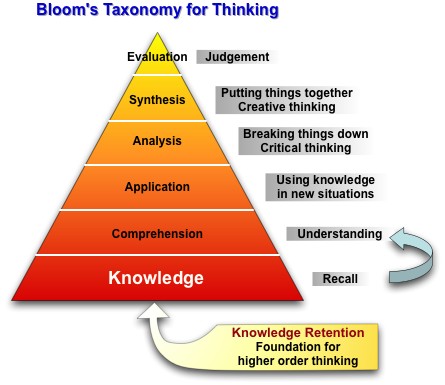 If you are presenting new information, is it reasonable to expect students to develop higher order thinking on that topic that day?
On Monday you introduce early American civilizations. Tuesday you need to cover the major civilizations; The Maya, The Aztec, and The Inca. Wednesday you need to move on to explores and you are no longer dealing with the Latin American civilizations.
How is it possible to present 3 major civilizations and cover all 3 societies histories in 1 day?
The Climax:
Our students never obtain higher order thinking skills because we rush through the curriculum. They do not get a firm understanding of the basic of how the world operates and are not able to contribute additional information to the established structures of society.
50 years pass and the world begins to fall apart because there is not enough intelligent people to sustain our society. Education has failed to complete its mission, failed to complete its purpose.
Okay, that is a little extreme, but that is why it is the climax.
The Resolution:
To prevent that and to combat any issues that arise out of "The Conflict" then teachers have to adapt.
Despite what education should be, what we have described is what education is. Teachers have to teach at a rapid a pace, and in the process we have to teach our students to develop higher order thinking skills.
In the said example:
As a teacher you have to pull out the highlights. The answer is that you can not cover these civilizations in any great detail. A successful teacher is preparred and ready to extract the major achievements of these societies.
In doing so a way to train your students to think critically and develop higher order thinking skills is to challenge them to make assumptions of the society based on the points that you bring up or present.
"The Mayas and Aztecs both built pyramids. What does that suggest about their society."
When you ask this question you are not just presenting information but the students are forced to make assumptions about the information. Now you are on a level 3 or 4 in Bloom's Taxonomy instead of level one.
Use a venn diagram that shows the similarities and differences in the 3 civilizations. Now students are comparing and contrasting information.
There are millions of ways to go about this. What methods do you use to get your students to use higher order thinking when your instruction time is limited?
